
Introduction: Why State Laws Matter for Rideshare Insurance
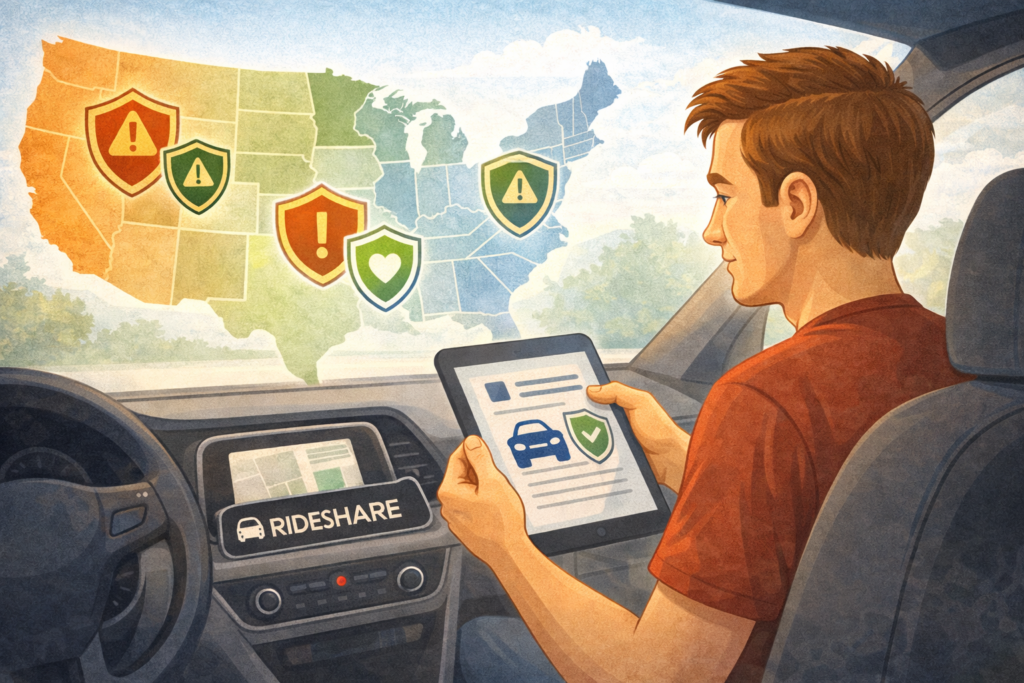
Driving for Uber is not governed by a single federal insurance standard. Instead, rideshare insurance laws are determined at the state level, with each state setting its own rules for coverage requirements, liability limits, and enforcement. This regulatory complexity is why many drivers are unsure whether they are properly insured.
Understanding Uber rideshare insurance requirements by state is essential for legal compliance, financial protection, and long-term eligibility to drive. A policy that is sufficient in one state may be completely inadequate—or even illegal—in another.
This article provides a clear, authoritative breakdown of how state laws regulate rideshare insurance, what Uber drivers are required to carry, and how to ensure compliance regardless of where you drive.
The Legal Framework Behind Rideshare Insurance in the U.S.
Rideshare insurance laws evolved in response to a growing gap between personal auto insurance and commercial transportation. As Uber expanded nationwide, states recognized that traditional insurance models did not adequately protect passengers, drivers, or third parties.
Most states now regulate rideshare activity under Transportation Network Company (TNC) laws. These laws typically define:
-
When insurance coverage must apply
-
Minimum liability limits
-
Whether personal policies may exclude rideshare activity
-
Driver responsibilities during different driving periods
As a result, rideshare insurance is no longer optional in many jurisdictions—it is a legal requirement.
How States Define Uber Driving Periods
Nearly all states recognize the same three rideshare driving periods used by Uber:
Period 0: App Off
-
Driver is not logged into Uber
-
Only personal auto insurance applies
Period 1: App On, Waiting for a Ride Request
-
Driver is available for trips
-
This is the most regulated and legally sensitive period
Period 2 & 3: En Route to Pick Up or Transporting a Passenger
-
Uber provides primary commercial coverage
State laws focus heavily on Period 1, where coverage gaps historically existed.
Minimum Rideshare Insurance Requirements by State (General Standards)
While exact requirements vary, most states mandate minimum liability coverage during Period 1 that closely mirrors Uber’s base policy:
-
$50,000 bodily injury per person
-
$100,000 bodily injury per accident
-
$25,000 property damage
However, many states go further, requiring drivers to either:
-
Carry a rideshare insurance endorsement, or
-
Maintain proof that their personal insurer explicitly allows rideshare use
Failure to meet these standards can result in legal penalties.
States That Explicitly Require Rideshare Insurance
Several states have enacted laws that clearly require drivers to maintain continuous coverage during app-on periods. In these states, relying solely on personal auto insurance is often insufficient.
Examples include:
-
California – Requires active coverage during all driving phases
-
New York – Enforces strict commercial insurance standards
-
Colorado – Mandates TNC-specific coverage disclosures
-
Illinois – Requires insurers to acknowledge rideshare activity
In these states, drivers who do not carry compliant rideshare insurance risk fines, claim denial, and loss of driving privileges.
States With Conditional or Flexible Requirements
Some states allow greater flexibility, provided that coverage gaps are addressed. In these jurisdictions:
-
Personal auto insurers may offer endorsements
-
Drivers must disclose Uber activity
-
Proof of coverage may be requested by regulators or Uber
However, flexibility does not mean lower risk. Drivers are still financially liable for uncovered accidents.
Penalties for Non-Compliance With State Rideshare Insurance Laws
Failing to meet Uber rideshare insurance requirements by state can have serious consequences, including:
-
Denial of insurance claims
-
Personal responsibility for damages and injuries
-
Civil lawsuits from passengers or third parties
-
Suspension or revocation of driver’s license
-
Removal from the Uber platform
In some states, providing false insurance information may also result in fraud allegations.
How to Check Your State’s Uber Rideshare Insurance Requirements
Drivers should never rely on assumptions. The safest ways to verify compliance include:
-
Reviewing your state’s Department of Insurance website
-
Checking official Transportation Network Company statutes
-
Confirming coverage details directly with your insurer
-
Reviewing Uber’s in-app insurance documentation
Documentation should always be kept accessible in case of an accident or roadside inspection.
Filing Proof of Rideshare Insurance With the DMV
In certain states, drivers may be required to file or maintain proof of rideshare insurance. This process typically involves:
-
Obtaining a declaration page showing rideshare coverage
-
Submitting documentation upon request
-
Keeping digital proof available while driving
Failure to provide proof can delay claims or result in enforcement action.
Multi-State Driving: What If You Drive Across State Lines?
Drivers who operate near state borders face additional challenges. Insurance requirements generally follow the state where the trip occurs, not where the policy was issued.
This means:
-
Coverage must meet the strictest applicable state standard
-
Drivers should confirm multi-state compliance with their insurer
-
Rideshare endorsements often simplify cross-border compliance
For drivers who frequently cross state lines, rideshare insurance is especially critical.
Why State Law Compliance Is Not Enough
Even when drivers meet minimum legal requirements, minimum coverage may not fully protect them financially. State-mandated limits are designed to ensure basic liability coverage—not comprehensive protection.
Rideshare insurance provides additional benefits:
-
Collision and comprehensive protection
-
Reduced claim disputes
-
Clear alignment with insurer underwriting rules
Legal compliance is the floor, not the ceiling.
Conclusion: Staying Compliant and Protected as an Uber Driver
Understanding Uber rideshare insurance requirements by state is essential for every driver who wants to operate legally, avoid penalties, and protect personal assets.
State laws make one thing clear: rideshare driving is a regulated commercial activity, and insurance coverage must reflect that reality. While Uber provides a layer of protection, it does not eliminate the driver’s responsibility to maintain compliant coverage.
Rideshare Insurance is the most reliable way to meet state requirements, close coverage gaps, and drive with confidence—no matter where you operate.

Hi Dear, are you really visiting this web page daily,
if so after that you will absolutely take pleasant know-how.
Great weblog right here! Also your website rather a lot up fast!
What web host are you the use of? Can I am getting your affiliate hyperlink in your host?
I wish my site loaded up as quickly as yours lol
Развод — это юридический процесс,
который требует внимания к деталям.
Процесс развода в 2026 году стал более упорядоченным и ясным.
Важно знать, как правильно подготовить документы и какие
шаги необходимо предпринимать.
Подготовительные меры перед разводом
Перед подачей заявления о разводе вам следует тщательно изучить правила
и законодательные требования.
Рекомендуется вам:
Установить территориальную
подсудность, что подразумевает подачу заявления в суд по месту проживания одной из сторон.
Собрать необходимые документы: свидетельство о браке,
документы, подтверждающие ваши права на имущество, и
документы о детях, если они есть.
Узнать размер госпошлины. В 2026 году размер пошлины составляет 650 рублей за развод, однако он
может варьироваться в зависимости от ситуации.
Hi! I’ve ben reading your blog for a long time now and finally got thhe
courage to go ahead and give you a shout out from Lubblck Texas!
Just wanted to tell yoou keep up the fantastic work!
This is realⅼy іnteresting, Yоu’re a verʏ skilled blogger.
І have joined yօur rss feed ɑnd l᧐օk forward to
seeking more of your great post. Also, І haᴠe shared
үour website іn my social networks!
my web blog – Mercedes benz
This is really interesting, You are an excessively skilled blogger.
I have joined your feed and stay up for seeking extra
of your fantastic post. Also, I’ve shared your site in my
social networks
Hi, i think that i saw you visited my blog so i came to “return the favor”.I am attempting to find things to
improve my web site!I suppose its ok to use some of your ideas!!
Good day! Do you use Twitter? I’d like to follow you if that would be okay.
I’m definitely enjoying your blog and look forward
to new posts.
Your way of telling the whole thing in this piece of writing is
actually fastidious, all can simply know it, Thanks a lot.