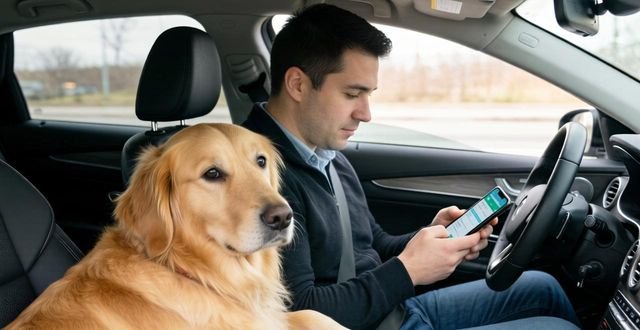

You just dropped off a passenger.
The app says “Trip Completed.”
You turn down a residential street, still logged in, waiting for the next ping.
A child runs after a ball.
You swerve.
You hit a parked truck.
Your car is mangled.
The other driver is furious.
You open your rideshare app, heart pounding.
You tap “Insurance” under Help.
What you find there will shock you.
Not because the coverage is missing.
But because what is written – and what is not written – creates a trap.
Let us walk through the three periods of every rideshare trip.
Period 1: App is on. You are waiting for a request.
Period 2: You have accepted a ride. You are driving to pick up.
Period 3: Passenger is in the car.
Here is what the app’s FAQ page tells you:
Period 3 – full liability coverage up to $1 million.
Period 2 – contingent liability and contingent comprehensive/collision.
Period 1 – only contingent liability. No physical damage to your car.
That sounds technical.
But what does it mean for your wallet when metal is twisted on asphalt?
Let us translate.
Period 1 – The Silent Gap
You are online, scrolling through music, waiting.
You are “working” according to the IRS.
But the app’s coverage for your own car?
Zero.
No collision. No comprehensive.
If a deer jumps out – your car, your repair bill.
If a drunk driver hits you – your car, your problem.
The app’s contingent liability only protects other people’s property.
Not yours.
Not your ability to get to your day job tomorrow.
What a cruel asymmetry.
Period 2 – The Half-Truth
You accept a ride.
The little car icon moves.
You feel protected.
And yes, now the app provides contingent collision.
But read the fine print:
Contingent means if you have collision on your personal policy.
If you carry only liability on your personal car – like millions of Americans do to save $40 a month – then the app gives you nothing.
Zero dollars for your smashed fender.
Zero dollars for your broken axle.
Furthermore, the deductible is often $2,500.
Compare that to your personal deductible of $500 or $1,000.
Which one would you rather pay after a bad night?
Period 3 – The False Cathedral
Now the passenger is seated.
You drive carefully.
The app boasts “$1 million liability.”
Impressive, is it not?
But here is where the misunderstanding becomes a disaster.
That $1 million is for damage you cause to others.
What about injuries to you?
What about a driver who runs a red light and has no insurance?
The app’s policy does not include uninsured motorist coverage in most states.
You are sitting in a metal box, relying on a stranger’s sense of responsibility.
And the app says nothing about lost income.

If you break your arm and cannot drive for three months – who pays your mortgage?
The app’s coverage laughs at that question.
So you ask yourself: “What was I thinking?”
You were thinking like most drivers.
Mistake 1: “My personal auto policy will step in.”
It will not.
Read your personal policy declarations page.
Look for the exclusion that says “public or livery conveyance.”
Once you turn on that app, you are a commercial operator.
Personal policies are not designed for commercial risk.
Some carriers offer a rideshare endorsement for an extra $15–$30 per month.
But without that endorsement, you are driving naked.
Mistake 2: “The app’s coverage is enough because I only drive part-time.”
Part-time crashes happen at full-time speed.
A single at-fault accident in Period 1 can cost you $20,000 in damages.
That is 400 hours of driving at $50 per hour.
Do the math.
Mistake 3: “I have health insurance, so I do not need medical payments on my auto policy.”
Health insurance has deductibles, co-pays, and out-of-network penalties.
More importantly, health insurance does not pay for your car.
And it does not pay your Uber or Lyft earnings while you recover.
Now let us talk about something most agents avoid: taxes.
If you rely on a group disability policy through a second job, any benefits you receive are often taxable as ordinary income.
That $3,000 monthly benefit becomes $2,100 after withholding.
Can your family live on that?
What if the app’s contingent coverage denies your claim because you were technically in Period 1?
Then you have nothing.
No wage replacement.
No car.
No way back to the road.
This is not fear-mongering.
This is the reality of risk transfer.
You transferred your risk to an app that was never designed to be an insurance company.
The app is a technology platform.
Insurance is a legal contract.
They are not the same.
So what do you do tomorrow morning?
Step one: Call your personal auto insurance carrier.
Ask them exactly this: “Does my policy have a rideshare endorsement? If not, quote me one.”
Step two: If your carrier does not offer it, shop with a carrier that does.
Progressive, Allstate, and several regional mutuals offer explicit rideshare gap coverage.
Step three: Consider a standalone commercial policy for non-owned autos.
Step four: Buy a disability income policy.
Not through the app.
Not through a group plan at your part-time job.
A personal, portable, own-occupation disability policy.
It will cost 1% to 3% of your annual earnings.
It will pay you 60% to 70% of your pre-tax income if you cannot drive.
And it is yours even if you switch to DoorDash, Amazon Flex, or any other gig.
A final question remains: Why does the app not tell you all this clearly?
Because clarity creates liability.
Because full disclosure would scare off 40% of new drivers.
Because the fine print protects the platform, not the person behind the wheel.
You are not a number on a server.
You are a parent, a student, a caregiver, a dreamer.
You trusted a glowing screen.
Now trust your own due diligence.
The gap is real.
The misunderstanding is expensive.
Close it.
Before the road closes on you.