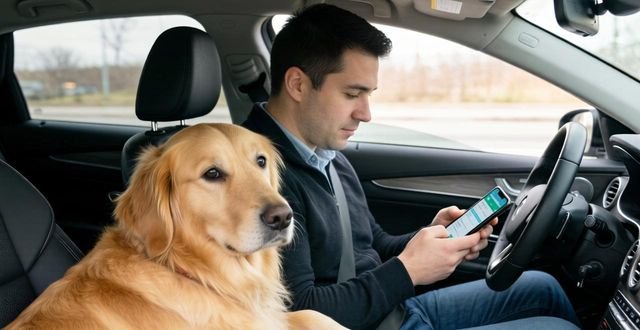

You are driving. 8:45 PM. A Friday.
Surge pricing just kicked in. Three more trips, you tell yourself. Enough to cover that property tax bill that jumped 12% this year.
Then it happens. A sedan runs a red light. T-bones your passenger door.
Everyone is fine. But your car? Not so much.
You pull out your phone. Open your personal auto app. File a claim.
That is when the adjuster asks the question.
“Were you online with Uber or Lyft at the time of the accident?”
Your stomach drops.
Because you remember now. You meant to activate that rideshare endorsement. You even called your carrier last month. Sat on hold for twenty-two minutes. Hung up.
Here is the truth most drivers learn the hard way: Personal auto policies exclude commercial use. Period. The moment you turn on that app, you are driving without coverage unless you have the right endorsement or a separate policy.
So let me walk you through exactly how to fix this. No fluff. No “paradigm shifts.” Just what works.
How Coverage Actually Works
Rideshare insurance lives in three phases. Think of them as gaps between your driveway and your first drop-off.
Phase 1 – App on, waiting for a ride request
Your personal policy says no. Most rideshare endorsements kick in here, but only for liability. Not collision. Not comprehensive.
Translation: If someone hits you while you are waiting near the mall, and you do not have the endorsement, your personal carrier will deny the claim. The rideshare company’s coverage? Also not active yet.
You are alone.
Phase 2 – Ride accepted, en route to pick up
Now Uber or Lyft’s contingent liability applies. Usually $1 million. Sounds great. Until you read the fine print.
Contingent means secondary. Your personal policy still has to deny first. And most rideshare endorsements only cover Phase 1. Not Phase 2.
This is where things get messy.
Phase 3 – Passenger in the car
Full rideshare coverage. Collision, comprehensive, liability. But here is the catch most people miss:
The deductible can be $2,500.
Not the $500 you chose for your personal policy. Read your agreement with the platform. I have seen drivers assume they were covered, only to realize they owed $2,500 before the insurance paid a single dollar for repairs.
How to Activate the Coverage (The Right Way)
Step one is not an app. Step one is a phone call.
Here is exactly what to say to your current auto insurer:
“I drive for Uber and Lyft about fifteen hours a week. Do you offer a rideshare endorsement in my state?”
Then listen.
If they say yes, ask these three questions:
1. What phases does it cover? (If they say only Phase 1,hang up and call another carrier.)
2. What is the deductible during Phase 2 and Phase 3?
3. Does this endorsement increase my premium if I file a claim?
If they say no, called a “hard no” state like California or New York with some carriers, you need a separate policy. Look for “commercial coverage for TNC drivers.” State Farm, Allstate, and Progressive offer versions in most markets. Farmers does in some.
The exact activation steps:
Call your carrier directly. Do not use the chat bot. Do not email. Speak to a licensed agent.
Tell them your average weekly online hours. Be honest. Lying about twenty hours when you actually drive forty is how claims get denied.
Ask for the endorsement in writing. An email. A PDF. Something you can save to your phone.

Verify the effective date. Usually starts the next day. Sometimes immediately. Never assume.
Then do this one extra thing no one tells you:
Save that endorsement document inside your glove box. Next to your registration.
Because when the cop asks for your insurance at an accident scene, you want to hand them the rideshare endorsement, not your personal card.
The Tax Trap Nobody Mentions
You want to know why some group policies through Uber or Lyft are actually worse deals?
Taxable benefits.
Here is how it works: If you buy insurance through the app, and the platform subsidizes part of the premium, the IRS often treats that subsidy as income. You get a 1099 for the “benefit” at the end of the year.
I had a driver last year. Let us call him Miguel. He paid $40 less per month through the in-app offer. Saved $480 over twelve months.
Then April came. His tax preparer showed him the 1099. He owed $210 on that “savings.”
Net benefit? $270.
Meanwhile, the policy had worse liability limits than the standalone endorsement he could have bought from a local mutual carrier for $35 more per month.
Miguel switched. Now he pays a little more. But his coverage actually works, and his taxes are clean.
Always calculate the post-tax cost. Not the sticker price.
Three Mistakes I See Every Six Months
Mistake #1: “My personal policy has rideshare coverage automatically.”
No. It does not. Unless you added the endorsement and have proof, assume you are uncovered. Most carriers exclude commercial activity in the base policy form. Read your declarations page. Look for exclusion language like “using the vehicle for livery or transportation network services.”
If you see those words, and you do not have an addendum, you are exposed.
Mistake #2: “I only drive a few hours a week. Not worth the extra cost.”
Let me give you a number.
The average at-fault accident with a passenger results in $47,000 in medical bills. That is just the emergency room and follow-up visits. Not the lawsuit if the passenger misses work.
Now compare that to the rideshare endorsement cost. Typical range? $15 to $40 per month depending on your state, age, and driving record.
So you are saving $300 per year to risk $47,000.
Does that sound like a trade you want to make?
Mistake #3: “My employer’s group plan covers me.”
This one hurts to hear. Because I have had to tell three different drivers this year that their group plan through a W-2 job does not cover lost income from rideshare accidents.
Group disability policies exclude “occupational pursuits outside of the insured’s regular employment.” You are not a full-time driver. You are a part-time contractor. The underwriters figured this out ten years ago.
Unless you bought an individual disability policy that explicitly lists “rideshare driver” as an occupation, assume you have zero income protection.
What to Do Tonight
You do not need a broker. You do not need a lawyer. You just need fifteen minutes and a phone.
1. Open your personal auto insurance declarations page. Search for the words “rideshare,” “TNC” (transportation network company), or “livery.”
2. If you see an exclusion, call your carrier right now. Do not wait until Monday. Their claims department works 24/7. So does their sales line.
3. Ask for the rideshare endorsement. If your current carrier does not offer it in your state, call Progressive. Call Allstate. Call a local independent agent like me who can shop ten carriers in ten minutes.
4. Once you add it, ask for the confirmation number. Write it on a sticky note. Tape it to your dashboard. Right next to the phone mount.
Because here is the thing no one wants to admit: Insurance is not about the premium. It is about the claim.
You are not buying paper. You are buying a promise that when that sedan runs the red light, you do not lose your car, your savings, and your ability to pay your mortgage in the same thirty seconds.
That Friday night surge pricing? It is only profitable if your coverage is active.
Make the call.